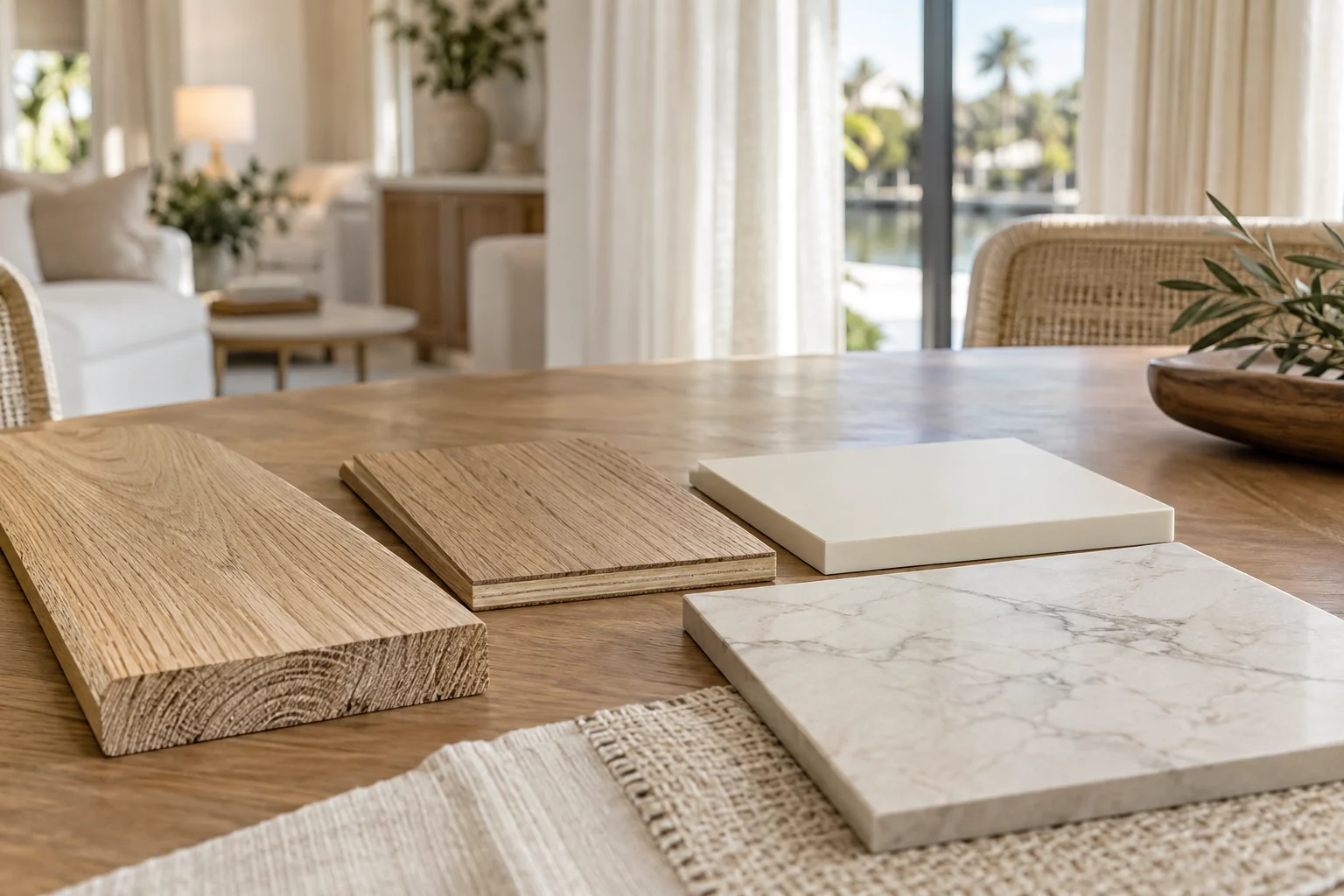
A Florida address does not make every interior wall a wet-area installation. An air-conditioned living room, a laundry room and a wall with recurring condensation have different conditions. Choosing a material starts with identifying those conditions, then checking whether the complete product and installation are suitable.
For homeowners planning paneling in Orlando and Central Florida, the important question is not simply “Is this moisture resistant?” Ask which part of the product is resistant, under what conditions, and what preparation and finishing it requires.
First distinguish humidity from a water problem
Decorative paneling should not be used to conceal an active leak or a persistently damp wall. Staining, swelling or recurring condensation needs investigation before a new finish covers it. A more expensive decorative face will not correct the condition behind it.
Also consider how the room operates. Is it normally air-conditioned? Is it left unconditioned for extended periods? Is the feature beside a sink or appliance connection? Those answers are more useful than a general promise that a material is “Florida-proof.”
Evaluate the complete material
Painted MDF. MDF provides a uniform surface that can suit painted interior details. Standard MDF and moisture-resistant grades are different products; do not treat the names as interchangeable. Ask for the specified grade and its permitted application.
Solid wood. Natural grain and variation can make wood a strong visual choice. Wood also responds to changes in moisture, so the detailing and installation need to account for the material rather than assuming it stays dimensionally unchanged.
Wood veneer panels. A real wood face does not identify the core beneath it. Check the substrate, backing, edge treatment and manufacturer's requirements alongside the veneer appearance.
Porcelain or stone finishes. A durable visible surface is only part of an installation. The backing, attachment method, joints and suitability for the wall conditions still need to be specified.
For a closer comparison of painted and wood finishes, see MDF vs. natural wood for wall paneling.
Four details to discuss before installation
- Conditioning and preparation. Follow the selected product's storage and acclimation instructions. Do not apply a single timing rule to every material.
- Exposed edges. Ask how cut edges, ends and penetrations will be finished. The attractive front face is not the only exposed surface.
- Location. Confirm that the product is suitable for the actual room and expected exposure, especially around water sources.
- Care. Request cleaning guidance for the finish you are buying. “Wipe clean” should not be interpreted as permission to soak it.
Use samples for more than color
Look at a sample from the side as well as the front. Ask what the layers are and how an installed edge will look. View it in the room during the day and evening. A finish that looks warm in a showroom can appear different beside your flooring and window light.
Keep the final product and finish information with your project records. It will be useful if a repair or addition is needed later.
Material references
The European Panel Federation explains differences in MDF moisture performance and the intended use of moisture-resistant grades. Always consult the specific product documentation before selecting a material.