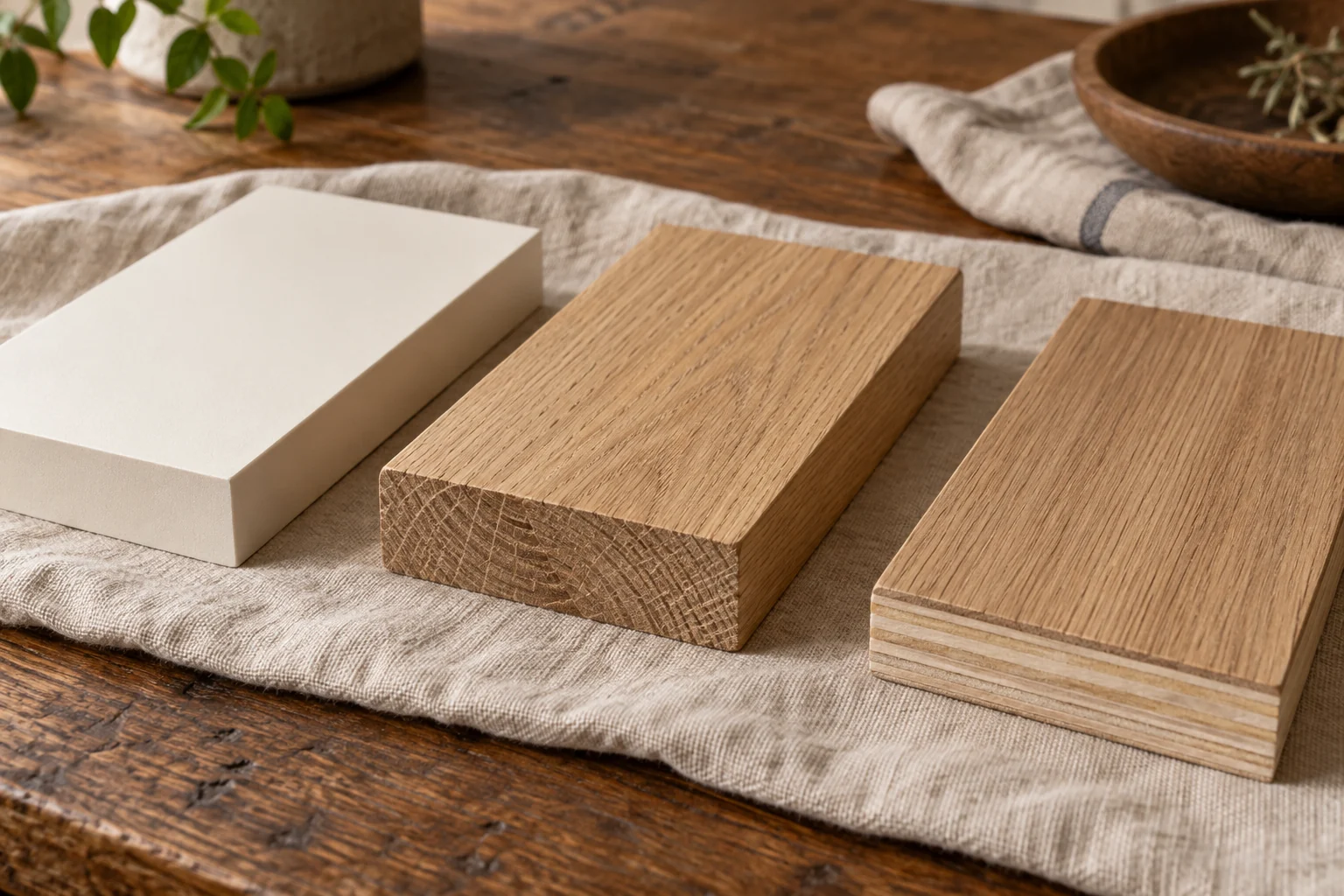
If you are choosing decorative wall paneling, “MDF or wood?” is only the first question. You also need to know whether the finish will be painted, whether visible grain is important, how the edges will be detailed and where the feature will be installed. A wood veneer panel adds a third option that is often missed in the comparison.
Start with the appearance you want, then ask for the construction behind that appearance. This is more useful than assuming the most natural-sounding material name is automatically the best specification.
Painted MDF: a uniform starting surface
MDF is a manufactured wood-fiber board. Its uniform surface can be useful for painted paneling and shaped interior details where visible wood grain is not part of the design. The final result still depends on preparation, edge finishing, paint and installation quality.
Ask which grade is specified. Standard and moisture-resistant products have different intended applications. Also ask how cut edges and joints will be finished; a smooth face alone does not ensure a refined finished wall.
Solid wood: grain with natural variation
Solid wood can provide the grain and character people want from an oak or walnut feature. Color and grain vary between pieces, so review how the material will be selected and arranged rather than expecting every slat to match a single small sample.
Wood responds to changes in moisture. Appropriate detailing matters, especially when pieces run over a large area. That is a material behavior to plan for, not a reason to assume wood cannot work indoors.
Veneer: a real wood face over a core
Veneer is a thin layer of wood applied to a substrate. It can provide a real wood appearance while using a different construction from a solid plank. Ask about the core, backing, exposed edges and finish. “Oak panel” does not tell you all of those things.
Veneer is not inherently a misleading product. The problem is an unclear description that leaves the homeowner expecting solid wood. A good proposal names the material accurately.
Compare the details that affect your decision
| Question | Why it matters |
|---|---|
| Will the feature be painted or show grain? | This determines which material qualities are visible in the finished room. |
| What happens at the exposed edges? | Corners and ends can reveal the construction and affect the appearance. |
| Is the room normally dry and conditioned? | Product suitability depends on the actual environment. |
| Will shelves or equipment attach to the wall? | Support needs should be planned separately from the decorative face. |
| How is the finish maintained? | Care and future repairs depend on the coating and construction. |
Compare installed scope, not just board prices
A material price does not include every step needed to turn it into a finished feature. Preparation, edge treatment, pattern layout, finishing and installation also contribute. Ask for two complete options for the same wall if you want a meaningful comparison.
For example, a painted feature and a wood-grain feature may require different finishing work even when the overall layout is similar. Avoid assuming one will always be cheaper in every configuration.
Questions to bring to a consultation
Ask to see the actual sample, including its edge. Confirm the full material name, finish, intended room conditions and how it meets the baseboard or ceiling. If you want to match existing cabinetry, bring a photograph and, where possible, a physical finish reference.
For Florida-specific concerns, read our humidity and material guide. For the visual pattern, compare board and batten with slat walls.
Material reference
The European Panel Federation explains MDF properties and dimensional behavior. Specific product documentation should guide the final selection.