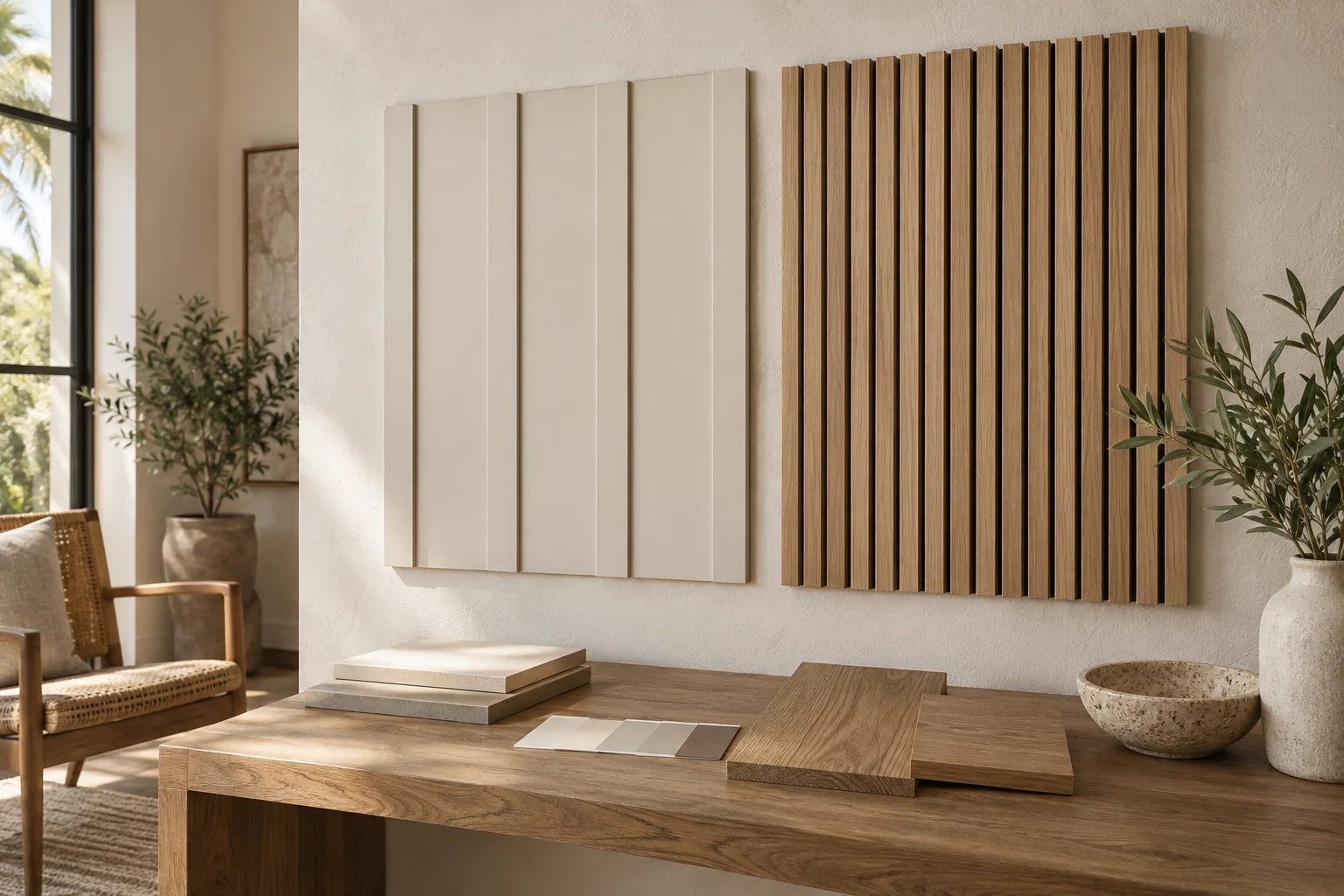
Board and batten creates a pattern with spaced battens over a wall surface. A slat wall uses a repeated series of narrower strips, often with visible gaps. Both can make a room feel more intentional, but they create different visual rhythms. The useful question is not which style is better; it is which one supports the room you already have.
How each treatment changes the room
Painted board and batten can read as part of the architecture, especially when its color is close to the surrounding trim. Wider spacing leaves larger quiet areas between the lines. Depending on the layout, it can suit a dining room, entry, bedroom or living room.
A slat wall introduces a finer repeated texture. Wood grain adds another layer of variation, while painted slats give a different result. In a room with patterned flooring, open shelving and strong furniture lines, a full wall of slats may feel busier than a smaller accent.
Neither style guarantees that a room will look taller or larger. Scale, lighting and the amount of wall covered matter.
Begin with the furniture, not the pattern
Mark the sofa, bed, console or dining furniture on the layout before choosing the spacing. A pattern should have a considered relationship to those elements rather than being centered on an empty wall that will later be partly covered.
For board and batten, check how the pattern ends at corners, doors and baseboards. For slats, decide whether they cover the entire wall or finish at a deliberate boundary. A narrow leftover strip at one edge can make a planned feature look accidental.
Compare materials honestly
Board and batten is a design treatment, not a material specification. It may use different products depending on the finish and location. Likewise, a wood-look slat panel may use veneer over a core rather than solid wood throughout. Ask what the complete product is, including the backing and exposed edges.
Our MDF, wood and veneer guide explains those distinctions. Do not decide only from the word “wood” in a product description.
What changes the installation scope?
Existing wall condition, pattern complexity, corners, outlet positions, finishing and lighting all matter. A simple painted layout is not directly comparable with a full-height slat installation that includes integrated lighting and custom returns.
If budget is a concern, compare two designs for the same wall and ask what is included in each. There is no universal rule that one treatment is always less expensive.
Light, sound and maintenance
Side lighting can make the depth of either treatment more pronounced. Test the finish under the room's daylight and evening lighting rather than relying only on a small online swatch.
Do not assume decorative slats will soundproof a room. If acoustic performance matters, ask for the tested performance of the actual panel assembly and installation. Visual texture alone does not establish that result.
Both treatments need cleaning around their edges and recesses. Slat gaps may require more careful dusting; painted surfaces should be cleaned according to the finish instructions. See our millwork care guide.
A practical way to choose
Choose board and batten if you prefer broader painted shapes and want the detail to relate closely to your trim. Consider slats if you want a finer texture or a wood accent, particularly in a defined part of the room. If you like both, use one as the main treatment rather than combining several patterns on the same wall.